 Galxe
Galxe connects Web3 quests with credentials and digital identity
- last updated
Galxe is a Web3 platform that combines community quests with credentials, identity verification, and campaign rewards. Projects set tasks and eligibility rules, while participants connect relevant accounts and participate under each campaign's reward conditions. Its identity products serve different purposes: an account links activity, Passport records identity verification, and Score summarizes reputation signals.
A quest can award points, collectible tokens, or a chance in a raffle. Those outcomes carry different conditions. The account that supplies a credential, the network that hosts a reward, and the payment method can each affect participation.
Community quests, token distribution, and identity tools
Galxe Quest gives projects a no-code system for creating campaigns that combine blockchain activity with off-chain participation. Tasks can involve educational material, quizzes, social engagement, or activity that a smart contract query can check. A project organizes these campaigns within its Space, the environment that holds its quests and community settings. Earndrop addresses token distribution, including campaigns with a single release or a vesting schedule. An eligible allocation can therefore become available all at once or in installments. That distribution schedule belongs to the campaign and remains separate from completing a Quest task.
Galxe Account links wallets and social profiles, while Passport supports identity verification. Score evaluates reputation signals, and the Identity Protocol lets applications issue and verify credentials. These products can support campaign requirements, although their presence does not make every requirement universal.
Credentials and the evidence behind tasks
A credential represents a defined fact or condition that a campaign checks about an account. Its meaning comes from the underlying data and verification method.
On-chain activity and holdings
Blockchain credentials can concern wallet balances, ownership of non-fungible tokens (NFTs), or interactions with a smart contract. On-chain means that the relevant record exists on a blockchain. The credential's requirements determine the eligible action or holding; an unrelated transaction does not establish that condition. Support for a network or credential type also needs to match the campaign.
Off-chain participation and imported records
Off-chain tasks use information outside the blockchain, including linked social accounts and records that the organizer supplies. Verification strength varies. X tasks using page-visit verification track intent, while Authentic Verification checks completed actions. Page-visit acceptance does not establish completion of the underlying social action. Updates to imported records follow the selected data source's refresh process.
Account access and permanent wallet bindings
Galxe accounts support wallet-based registration and social sign-in, which allow different starting points for participation. The sign-in method alone does not establish every reward prerequisite.
Social access and wallet connections
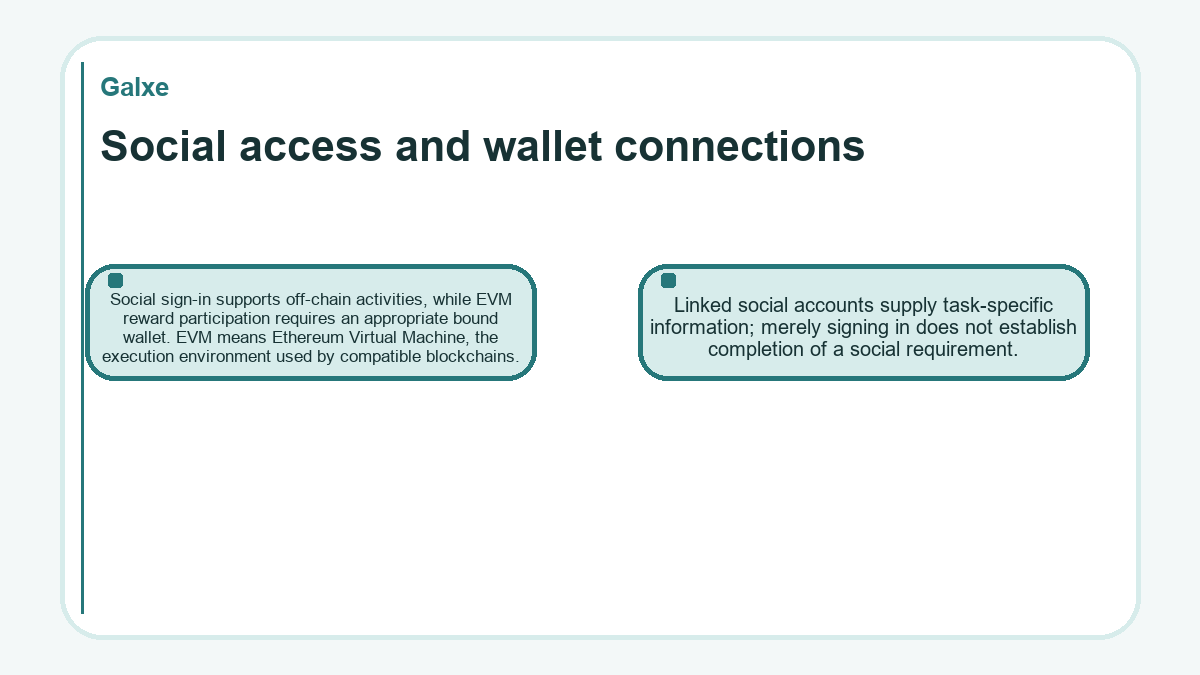
Social sign-in supports off-chain activities, while EVM reward participation requires an appropriate bound wallet. EVM means Ethereum Virtual Machine, the execution environment used by compatible blockchains. Linked social accounts supply task-specific information; merely signing in does not establish completion of a social requirement.
Primary and secondary addresses
The primary EVM address is publicly visible and cannot be changed or unbound. It receives EVM Quest rewards. Secondary addresses serve additional account and credential purposes without replacing that primary recipient. Earndrop has a distinct supported path that permits claims using a secondary EVM address. Linked social accounts also carry participation history. Moving a social account to another profile forfeits access to rewards claimed with that account and can affect ongoing quest eligibility. Previously completed quests cannot be reclaimed through the replacement account.
Reward types and allocation rules
A campaign's reward setting determines what meeting its requirements makes available. Eligibility, winning a draw, and receiving an asset describe different outcomes.
Points and achievement tokens
Loyalty points record participation within a project's program. Organizers can use them for leaderboards or access conditions. On-Chain Achievement Tokens, or OATs, record qualifying accomplishments through blockchain tokens. Holding points or an OAT establishes the relevant recorded achievement; a later token allocation requires its own campaign rules.
Points contracts can operate on supported networks beyond Gravity. The selected deployment governs where those points exist, so a blockchain record does not make every project's points interchangeable. Redemption arrangements belong to the organizer's program.
First-come claims and raffles
First-come, first-served distribution awards available rewards under the campaign's eligibility and capacity conditions. A raffle selects winners from eligible entries. The token reward system distinguishes the off-chain first-come process from on-chain raffle participation. Completing a raffle's tasks creates eligibility for the draw and does not establish a winning allocation.
Fixed and variable winning allocations
A fixed token raffle assigns the same reward amount to each winner. A luck-based token raffle divides the pool randomly among winners, so winning allocations can differ. Winners must claim within the applicable deadline. An available reward can become unclaimable when its applicable window closes.
Passport verification and reputation scores
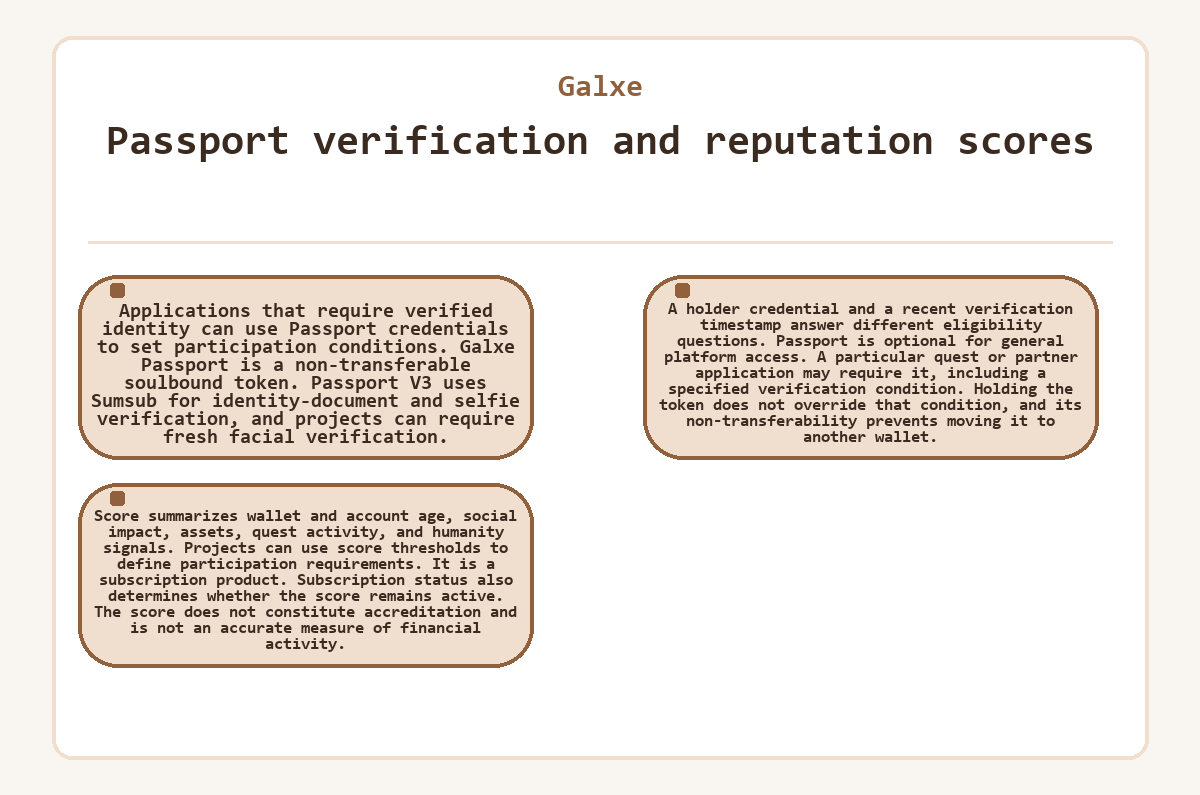
Applications that require verified identity can use Passport credentials to set participation conditions. Galxe Passport is a non-transferable soulbound token. Passport V3 uses Sumsub for identity-document and selfie verification, and projects can require fresh facial verification. A holder credential and a recent verification timestamp answer different eligibility questions. Passport is optional for general platform access. A particular quest or partner application may require it, including a specified verification condition. Holding the token does not override that condition, and its non-transferability prevents moving it to another wallet.
Score summarizes wallet and account age, social impact, assets, quest activity, and humanity signals. Projects can use score thresholds to define participation requirements. It is a subscription product. Subscription status also determines whether the score remains active. The score does not constitute accreditation and is not an accurate measure of financial activity.
Selective disclosure and campaign privacy
Privacy depends on the information disclosed in each interaction. The Identity Protocol uses zero-knowledge proofs to verify credential conditions with selective disclosure. Passport's holder credential confirms token possession without revealing the holder's identity during Quest participation. Public wallet addresses and blockchain transactions remain observable. Campaign surveys create a separate disclosure: organizers can export submitted responses. Account permissions, identity-verification data, and survey answers therefore have different recipients and protections. Encryption within an identity product does not make every campaign submission private.
Claim costs and payment options
Participation costs can include the activity required by a task, the reward claim, and a payment-service charge. A sponsored claim does not cover unrelated blockchain activity.
Gas pays for processing an on-chain transaction. A platform claim fee is a separate charge. Projects can fund a Gas Station and enable gasless participation for eligible claims. For points claims on Gravity, insufficient Gas Station funds can produce a request for participant-paid gas.
Smart Balance provides a shared payment balance for supported claims and products, including Passport and Score. It can cover supported network payments without keeping a separate gas balance for each claim network. Its service charges remain separate from the campaign's reward amount and any underlying task cost.
Smart Balance does not generate yield, and issued credits are non-refundable and cannot be withdrawn. Legacy Smart Savings funds have a separate transition rule: holders may withdraw or migrate them before November 1, 2026. Remaining legacy balances migrate automatically after that date. Withdrawal availability for those older funds does not extend to Smart Balance deposits.
Gravity infrastructure and the G token
Gravity provides blockchain infrastructure for the ecosystem, and G is its native gas token. The earlier GAL token was upgraded to G, which also has ecosystem payment and governance uses. Campaign rewards can involve other project tokens; a reward allocation is not automatically an allocation of G.
Gravity-related Quest contracts have moved from Gravity Alpha Mainnet to Gravity L1 Mainnet. Direct-wallet claims against those contracts require gas funds on Gravity L1 Mainnet. G held on the older network does not satisfy that requirement; without sufficient G on Gravity L1 Mainnet, the direct-wallet claim fails. This applies to the affected contracts, while rewards and points on other supported networks retain their own network requirements.
Gravity Alpha Mainnet is scheduled for deprecation on November 1, 2026, after which remaining assets will no longer be transferable. The Galxe G Staking dashboard is also scheduled to close on that date. Existing stakers need to submit unstaking requests early enough for the seven-day lock-up to finish before the dashboard closes; the retirement concerns that product and its affected deposits.
Project Spaces and campaign administration
A Space lets an organizer create and manage quests, configure rewards, and examine participation reports. Eligibility settings can draw on prior Space participation, loyalty points, holdings, and identity or reputation credentials. Such conditions belong to the organizer's campaign and should describe the intended activity accurately.
Task verification also requires suitable data. A survey can collect a submission without establishing that the answer is valid. Organizers can review those responses and build a follow-up credential from approved entries. Requiring completed participation therefore calls for a verification method that actually measures completion.
Earndrop handles a separate distribution task through campaign-specific eligibility, a selected token contract, and release conditions. The organizer can configure a public or private campaign and a one-time distribution or vesting arrangement. A project's distribution choice determines when an eligible participant can receive tokens.
Rechecking a completed task before repeating it
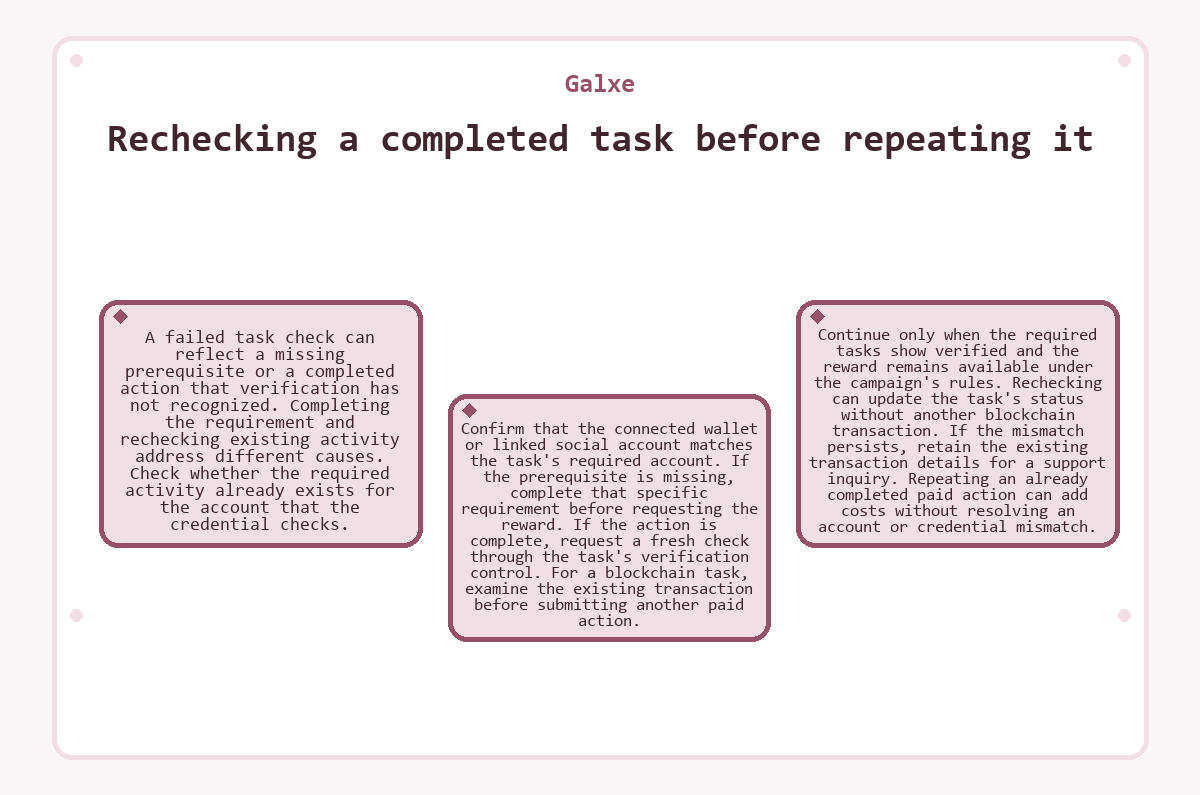
A failed task check can reflect a missing prerequisite or a completed action that verification has not recognized. Completing the requirement and rechecking existing activity address different causes. Check whether the required activity already exists for the account that the credential checks.
- Confirm that the connected wallet or linked social account matches the task's required account.
- If the prerequisite is missing, complete that specific requirement before requesting the reward.
- If the action is complete, request a fresh check through the task's verification control.
- For a blockchain task, examine the existing transaction before submitting another paid action.
- Continue only when the required tasks show verified and the reward remains available under the campaign's rules.
Rechecking can update the task's status without another blockchain transaction. If the mismatch persists, retain the existing transaction details for a support inquiry. Repeating an already completed paid action can add costs without resolving an account or credential mismatch.
Research tools and historical engagement data
Alva provides AI-assisted crypto research, while platform dashboards describe quest participation and ecosystem activity. Galxe Verify checks whether contacts or links are associated with the platform. That association check addresses contact authenticity; it does not validate another project's campaign economics or permissions.
Galxe Starboard was discontinued on August 3, 2026. Its aggregate views retain frozen historical information, and individual project contributor rankings are no longer visible on the frontend. New posts no longer enter its indexing system. A visible historical ranking therefore cannot establish recognition for a new contribution.
Galxe: quick answers
Why can an Illegal Signature error appear during a claim?
An Illegal Signature error can arise from a device date or time synchronization problem. Correct clock settings can address that cause, and claiming on a mobile device is another documented alternative. The error alone does not establish an eligibility failure. Campaign requirements, wallet connectivity, and reward availability remain separate conditions for a successful claim.
How frequently does Galxe Score incorporate new activity?
Galxe Score follows a weekly update cycle, so new activity does not immediately change the displayed score. Its calculation considers several signals, including wallet history, assets, social impact, and quest activity. A persistent discrepancy can be raised with support.
Does gasless entry to a luck-based raffle cover the winner's token transfer?
Gasless participation in a luck-based token raffle can still leave the winner responsible for the prize transfer fee. That later charge depends on the blockchain that hosts the reward token. Sponsoring raffle entry and paying to move a winning allocation are separate operations, so the entry's gasless setting does not establish a free prize transfer.
When do unused Smart Balance credits expire?
Issued Smart Balance credits have a validity period of one year. They are also non-refundable and cannot be withdrawn, so an unused balance does not remain available indefinitely or behave like a withdrawable wallet deposit. Legacy Smart Savings funds have different transition arrangements; their withdrawal option does not apply once funds move into Smart Balance.
Is an EVM-compatible wallet required to create a project Space?
Creating a Galxe Space requires an EVM-compatible wallet address. Social, email, or non-EVM access alone does not satisfy that organizer requirement. A personal account and a Space serve different purposes: the account supports participation, while the Space manages campaigns. The wallet requirement for creating a Space should not be applied to every participant login.
Can a mobile browser mint a Galxe Passport?
A mobile browser supports Passport minting, while the Galxe mobile app does not support that operation. Browser-based minting still requires the applicable wallet connection, payment, and identity-verification steps. Using a phone does not replace those requirements or bypass a campaign's Passport conditions.